
Modern manufacturing requires more than producing parts; it demands precision, efficiency, and the flexibility to accommodate a wide range of materials, designs, and production volumes. As manufacturing requirements become increasingly complex, selecting the right machine fabrication services provider is essential to achieving the desired quality, performance, and cost objectives.
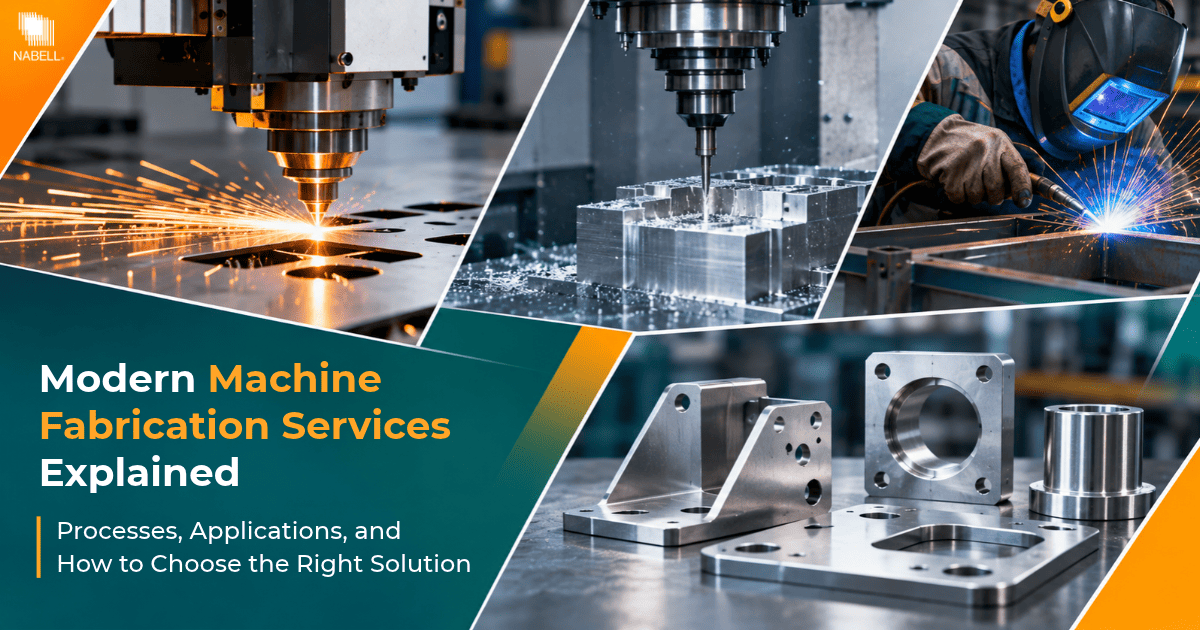
A modern machine fabrication shop brings together advanced capabilities such as laser cutting, machining, welding, and sheet metal fabrication under one roof, allowing manufacturers to streamline production and simplify project management. Understanding how these manufacturing processes differ helps ensure the right method is selected for every application. This post explores the core services offered by a modern machine fabrication shop, the key factors to consider when selecting a manufacturing process, and the industries that benefit from today’s machine fabrication services.
What Is a Modern Machine Fabrication Shop and What Services Does It Offer?
A modern machine fabrication shop integrates multiple manufacturing technologies to produce precision components, structural assemblies, and custom-engineered products from a single facility. The following are some of the core machine fabrication services machining shops offer to support today’s manufacturing requirements.
- Laser Cutting Services: These services use a CNC-controlled, high-powered laser beam to cut sheet metal and plate materials with exceptional precision and repeatability. Suitable for carbon steel, stainless steel, aluminum, brass, copper, and other metals, the process produces clean edges, intricate profiles, and minimal material waste, making it ideal for sheet metal fabrication, enclosures, brackets, panels, and precision-engineered components.
- CNC Routing Services: CNC routing removes material using high-speed rotating cutting tools to produce precise profiles, cutouts, pockets, and complex shapes. It is commonly used for plastics, composites, wood, aluminum, and other non-ferrous materials where laser cutting may not be appropriate. The process delivers excellent dimensional accuracy, smooth edge quality, and efficient production for prototype and production applications.
- Precision Machining Services: Precision machining services utilize advanced CNC equipment to manufacture components requiring tight tolerances, complex geometries, and superior surface finishes. These services combine milling to create complex features and profiles, turning to produce precision cylindrical components, drilling to create accurately positioned holes, and tapping to generate internal threads for fasteners. Together, these machining processes support the production of high-performance mechanical parts used across aerospace, automotive, medical, industrial automation, and general manufacturing applications.
- Metal Fabrication: Metal fabrication services combine cutting, forming, bending, rolling, and assembly to manufacture structural frameworks, machine bases, enclosures, brackets, platforms, and custom assemblies. These integrated processes produce strong, accurately fabricated components while supporting both prototype development and full-scale production across diverse industrial applications.
- Welding Services: Welding joins two or more metal components by applying heat, pressure, or both to create strong, permanent connections. Suitable for a wide range of ferrous and non-ferrous metals, the process supports structural fabrication, machinery, equipment frames, pressure assemblies, and custom manufactured products requiring long-term strength and durability.
- Finishing Services: Finishing services enhance the quality, appearance, and functionality of manufactured components through processes such as deburring, grinding, polishing, bead blasting, coating, and surface preparation. These operations improve surface finish, remove manufacturing imperfections, enhance corrosion resistance where required, and prepare parts for assembly, painting, coating, or final production.
Choosing the Right Manufacturing Process for Your Project
Modern machine fabrication shops offer a wide range of manufacturing capabilities, each designed to address different materials, component geometries, and production requirements. Selecting the right process is essential for achieving the desired quality, efficiency, and performance. Consider the following factors when evaluating the best manufacturing approach for your project.
- Material Type: Assess the material being processed to identify the most suitable manufacturing method. While laser cutting is ideal for many metals, CNC routing is commonly used for plastics, composites, and wood. Selecting a process compatible with the material helps achieve the desired quality, efficiency, and manufacturing performance.
- Part Geometry: Analyze component shape, feature complexity, wall thickness, and overall design requirements before selecting a process. Flat profiles are often produced through laser cutting, while complex three-dimensional features, pockets, and contoured surfaces typically require precision machining operations.
- Required Tolerances: Define dimensional accuracy and surface finish requirements early in the design process. Applications demanding tight dimensional accuracy and superior surface finishes generally benefit from precision machining services, while standard fabrication processes are often better suited for structural components with less stringent tolerance requirements.
- Production Volume: Determine whether the project requires prototype, low-volume, or high-volume production as each of these require different manufacturing strategies. Selecting the appropriate fabrication process helps balance tooling requirements, manufacturing efficiency, lead times, and overall production costs.
- End-Use Application: Consider operating conditions, structural demands, mechanical loads, corrosion exposure, and assembly requirements to be able select the most appropriate manufacturing process and ensure long-term performance.
Machining Process Selection Guide
Selecting the appropriate manufacturing process depends on the specific requirements of your project. The following table provides a general overview of common manufacturing needs and the processes typically used to achieve the desired results.
| Project Requirement | Recommended Process |
|---|---|
| Precision sheet metal components | Laser Cutting Services |
| Plastics, composites, and non-ferrous materials | CNC Routing Services |
| Cylindrical components | CNC Turning Services |
| Flat surfaces, pockets, and complex geometries | CNC Milling Services |
| Accurate holes and internal threads | Drilling & Tapping Services |
| Structural assemblies and fabricated products | Metal Fabrication & Welding Services |
| Product development and design validation | Prototyping Services |
| Surface preparation and final part finishing | Finishing Services |
Industries That Benefit from Modern Machine Fabrication Services
Modern machine fabrication services support diverse industries with precision manufacturing, fabrication, machining, and assembly capabilities. The following are some of the industries that benefit from these services.
- Aerospace: Aerospace manufacturers rely on precision-fabricated and machined components that meet demanding quality, dimensional accuracy, and performance requirements. Modern fabrication processes support the production of brackets, structural components, fixtures, housings, and specialized aerospace parts.
- Automotive: From prototype development to production manufacturing, the automotive industry utilizes fabrication, machining, welding, and assembly processes to manufacture chassis components, brackets, fixtures, tooling, enclosures, and precision mechanical parts.
- Medical: Medical equipment manufacturers require accurately manufactured components for diagnostic equipment, laboratory instruments, surgical devices, and healthcare technologies. Precision machining and fabrication help produce reliable parts that meet stringent quality expectations.
- Industrial Automation: Machine builders and automation system manufacturers depend on fabricated frames, machine bases, guarding, brackets, mounting structures, and precision-machined components to build automated production equipment and robotic systems.
- Electronics: The electronics industry uses sheet metal fabrication, laser cutting, and precision machining services to manufacture enclosures, panels, mounting hardware, heat sinks, chassis, and other components used in electrical and electronic equipment.
- General Manufacturing: Manufacturers across diverse industrial sectors utilize metal fabrication services, precision machining services, and custom manufacturing services to produce production equipment, fabricated assemblies, replacement parts, custom components, and application-specific products that support everyday manufacturing operations.
Partner with Nabell for Precision Machining & Fabrication Services
Whether you require precision-machined components, fabricated assemblies, or complete custom manufacturing solutions, Nabell delivers reliable custom fabrication services in North Carolina tailored to your project requirements. Our comprehensive manufacturing capabilities, experienced engineering team, precision-focused production processes, and rigorous quality inspection help ensure consistent results from concept through final production. From laser cutting services and welding and fabrication services to custom manufacturing, we provide integrated solutions designed to meet your technical specifications, production volumes, and performance expectations. Contact our team today to discuss your project!